Sunday, July 27, 2008

Fence shell-ters turtles in traffic

By Renee Nadeau | Sunday, July 27, 2008 |
Photo
Photo by Courtesy

Animal advocates are hoping a threatened turtle is in the fast lane to survival thanks to a highway fence erected by volunteers.

Volunteers from Bristol-Myers Squibb in Devens, the state Fish & Wildlife Services and MassHighway erected the fence along a busy highway in central Massachusetts, reducing the turtle mortality rate along the stretch.

That was good news for the Blanding’s turtle, listed as “threatened” by the state’s Natural Heritage and Endangered Species Program. “I think it’s clear that this fencing has been a huge success,” said Lori Erb, a MassWildlife biologist.

In 2007, 43 turtles were killed crossing the highway, including five Blanding’s turtles. Volunteer efforts dropped the death toll to a mere four traffic deaths. No Blanding’s turtle was killed by a car.

Traffic accidents are the leading cause of death among Blanding’s turtles, a species with a low survival rate among young turtles. The turtles travel to several wetlands between mid-March and October and cross dangerous highways in their travels.

Article URL: http://www.bostonherald.com/news/regional/general/view.bg?articleid=1109303

Wild about Turtles!

Wild about Turtles

Thursday, Aug. 14, 2008 at 2 p.m. Children ages 3 and older will meet turtles, learn songs and make a clay turtle.

Naturalist Mary Doane will lead the program.


The Ashby Free Public Library, Main Street in Ashby. Library hours are from 10 a.m. to 5 p.m. Tuesday, 1 to 8 p.m. Wednesday and Thursday and closed Saturday during July and August. For more information or to sign up for a program, call (978) 386-5377.

Friday, July 25, 2008

Turtles at Wachusett Meadow

Sunday July 27, 2008

Turtles at Wachusett Meadow
Learn about turtles in the area, 1-3 p.m. Massachusetts Audubon Society adult members, $6; adult nonmembers, $8; child members, $3; child nonmembers, $4.

Wachusett Meadow Wildlife Sanctuary

113 Goodnow Road
Princeton, MA 01541
978-464-2712

e-mail:
wachusett@massaudubon.org

Thursday, July 24, 2008

As endangered turtles wash ashore, scientists get a rare glimpse


As endangered turtles wash ashore, scientists get a rare glimpse

CUTTYHUNK ISLAND - Seagulls, strangely absent from this quaint summer getaway, feasted Monday along the rocky shoreline, and Carrie DeArmond and her daughter, Jordan, knew something was amiss.

"There were five or six and then another and another," DeArmond said. "And then I said, 'Oh, my God, would you look at that.' "

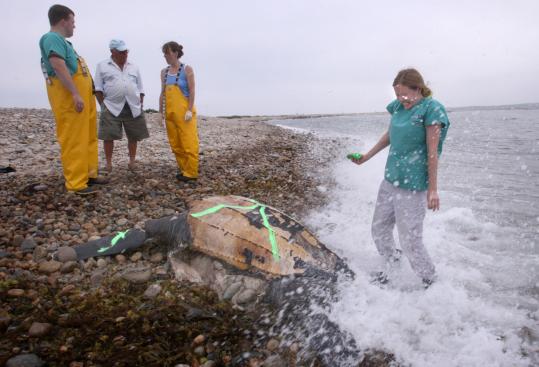
Lying in a patch of mud-colored seaweed was one of the ocean's largest, most mysterious reptiles: the leatherback turtle.

"But she smelled," Jordan said. And it was dead, the third of the rare and endangered species to wash ashore in Massachusetts in the past three weeks. Researchers typically see one or two each year.

"You could be a marine biologist for a long time and not come in contact with a leatherback," said Tony LaCasse, a spokesman for the New England Aquarium. "And we could go another couple years without seeing another."

Word of the 500-pound turtle spread quickly through the island community and among scientists eager to study the carcass for clues about the life of the leatherback. New England Aquarium researchers headed to the island yesterday morning to examine the turtle.

Distinguished by its unusual shell, a soft, vinyl-like skin over laying tiny interlocking bones, with seven ridges running front to back, the leatherback has roamed the world's oceans for about one hundred million years.

Adults can measure as long as 6 1/2 feet and weigh up to 2,000 pounds, and are thought to live for more than 100 years. They spend much of their life close to the ocean surface, feeding on jellyfish, but have been spotted more than 4,000 feet underwater, LaCasse said.

Boat propellers, fishing lines, and beach development contributed to the leatherback's rapid decline between the 1950s and 1980s, LaCasse said. Only an estimated 34,500 females existed worldwide in 1996, according to a report last year by the National Marine Fisheries Service and US Fish and Wildlife Service. The most recent population estimate for the North Atlantic alone ranges between 34,000 and 94,000 adult leatherbacks, the study said.

More than 40 sightings have been recorded in the waters of Nantucket Sound and Vineyard Sound this year, said Connie Merigo, director of the Marine Animal Rescue program at New England Aquarium. But some of those may be the same turtle, Merigo said, and "we don't have an exact number."

This year's first dead turtle was spotted July 3 on Popponesset Beach in Mashpee. The second came ashore July 13 on Ricketson's Point in Dartmouth, and the latest washed up here earlier this week. Researchers say the turtle was probably killed by a boat propeller, but they don't know for sure.

Residents struggled to prevent full-moon tides from reclaiming the leatherback, DeArmond said, and it took seven people tugging at the turtle to keep it from washing away Monday night.

The turtle was eventually tied to an anchor about 20 feet inland and restrained with a small, green net.

The aquarium team had about an hour to analyze the turtle yesterday and collect samples before high tide made work impossible. The leatherback was significantly decayed: Its left side was split open, seagulls had pecked away the eyes, and much of the skin on its back had peeled away.

"It's in pretty bad shape in terms of what we can learn," said Sheila Sinclaire, an aquarium biologist. "We can't even tell for sure whether it's male or female."

Tags on the turtle's front flipper indicate the leatherback originated from the Caribbean, near Trinidad. It appeared to be a young adult, Sinclaire said, but an electronic tag found implanted in its muscle may lead to more information.

Leatherbacks live throughout the world, but this one probably nested in the tropics and followed migrating jellyfish up the US Eastern Seaboard, LaCasse said.

Unlike other cold-blooded animals whose internal temperature changes with their surroundings, the leatherback can moderate its heat and swim into colder waters. And had it not died, it would have returned south, possibly to the same beach where it was born, researchers speculate.

Instead, it landed on the shores of Cuttyhunk, and residents flocked to watch the team of scientists collect samples.

"I've seen sea turtles, but nothing like this," said Ben Snow, 11, who was sitting in a line of friends as biologist Adam Kennedy examined a flipper.

"There was a sense of protectiveness on the island about it," said Kathleen Patton, a summer resident from Milton who questioned researchers about what may have killed the turtle. "We almost wanted to have a little service for it."

© Copyright 2008 The New York Times Company

Wednesday, July 23, 2008

Another dead sea turtle washes ashore

Another dead sea turtle washes ashore

By KEVIN P. O'CONNOR
Standard-Times correspondent
July 22, 2008 6:00 AM


A sea turtle washed up on Cuttyhunk on Monday, the third dead leatherback found on the southern coast of Massachusetts this month.

Wildlife experts headed out to the island after receiving a call in the early afternoon, hoping to learn more about the animal and how it died.

"It is a female, about 500 pounds, that was tagged from West Trinidad," said Bob Prescott, sanctuary director for the Massachusetts Audubon Society's Wellfleet Bay Wildlife Sanctuary.

"We are trying to learn as much about it as we can."

The latest dead leatherback follows two of its kind on southern Massachusetts beaches.

Keith Kauppila found one washed up on the rocks in front of his house on Ricketson's Point in Dartmouth on the night of July 13. That came after a day of heavy surf produced by Hurricane Bertha.

Another leatherback was found on Popponesset Beach in Mashpee on July 3.

This is the season for sea turtles. From New Bedford to Provincetown, leatherbacks and loggerheads have been popping up with regularity in the warm waters of Buzzards Bay and the Nantucket Sound.

There could be more of them nearby this year because they were pushed up the coast by Hurricane Bertha. Or it could be people are just seeing them more, wildlife officials say.

"We get called out 15 or 20 times a year to free turtles that get tangled in fishing gear," said Brian Sharp, a rescue associate with the Provincetown Center for Coastal Studies.

"We are getting a lot of calls about turtles this year," Mr. Prescott of the Audubon Society said.

"The water is warm this year. It might be that. We are also told there are a lot of jellyfish (which the turtles eat) in the area. It might be that. But it does appear there are more leatherbacks than usual this year."

In Rhode Island and Connecticut, biologists from the Mystic Aquarium respond to calls of turtles in distress. There have been three dead loggerheads in Rhode Island in July.

"We are getting a few more calls, but not significantly more," said Cindy Davis, a stranding assistant with the Mystic Aquarium. "We get calls from July to October."

There are five types of sea turtles that make their way into these waters in the summer, swimming up from the coast of South America and the Gulf of Mexico, following the Gulf Stream to Cape Cod and sometimes up to Maine.

Leatherbacks are the largest of the group. They weigh 500 to 1,000 pounds. Their backs, 5 feet across, look like the brown bottom of an overturned rowboat.

Loggerheads and Kemp's Ridleys are generally around 30 inches long and 100 pounds. Kemp's Ridleys are often found stranded on the beaches of southern Massachusetts. Green turtles and hawksbills are rare visitors.

None of those turtles is common. All are either listed as endangered or threatened species. And they are not numerous.

"We are getting more calls this year reporting them, but we don't know if that is because people are reporting more and we are getting more calls about the same turtles," Mr. Prescott said. "We believe we have 10 to 15 leatherbacks in Buzzards Bay and Vineyard Sound."

That number was reduced by one some time before July 13.

"I took my dogs out for a walk that night and one of them pointed on something," Mr. Kauppila said. "It was a huge turtle. It has a flipper span of 7 feet. The heavy seas brought it right to my front steps."

Mr. Kauppila got on the phone, eventually reaching the New England Aquarium in Boston, which dispatched a research team to dissect the turtle and collect samples.

"It had very significant propeller wounds to its back, but it is unknown if that happened before or after it died," said Tony LaCasse, spokesman for the New England Aquarium. The turtle was so badly decomposed it could not be determined if it died because it was hit by a boat or if it was run over after it died, he said.

Researchers still learn a lot by examining the turtle. Mr. Prescott said they look for tags — the female found Monday on Cuttyhunk was tagged by biologists in Trinidad when it was a baby, he said.

They also take tissue samples looking for parasites and chemical contaminants and try to examine the content of the animal's stomach to determine how it lived and why it died.

If a living turtle is seen swimming freely, that should be reported to 1-800-SEA-TURT, 1-800-732-8878. Biologists use that information to track migration patterns of the turtles, Mr. Sharp said.

Dead turtles should be reported to the New England Aquarium at (617) 973-5200. If you spot a turtle that is sick or injured or entangled in rope, litter or fishing gear, call the Provincetown Center at 1-800-900-3622.

"We ask people, if they can, to back off 100 or 200 feet and keep the turtle in sight until help arrives," said Mr. Sharp of the Provincetown Center. "We work with harbormasters and the Coast Guard. We can usually respond within an hour or so."

Turtles entangled in rope and fishing gear usually swim away before help arrives, Mr. Sharp said, so boaters are asked to keep the animals in sight so they can direct rescuers to the turtle.

No one should touch the turtles or try to help them, Mr. Sharp said.

"We want to make sure the animal is disentangled properly," he said. "We'll make sure all the lines are freed and we'll provide what veterinary care that we can. We try to maximize the chances the animal will survive."

And they like to see the turtles themselves, Mr. Sharp said.

"We try to get as much data as we can," he said. "Every time we go out, we learn something new."


Source: SouthCoastToday.com

New Devens arrival seeks to save older one


New Devens arrival seeks to save older one
By Kate Augusto
Globe Correspondent / July 20, 2008

In a green version of good corporate citizenship, employees of the yet-to-be opened Bristol-Myers Squibb plant in Devens are donating their time to protecting and restoring the habitat of the Blanding's turtle, a threatened species in the area.

The pharmaceutical company's efforts to preserve wildlife, which have included restoring a fence to keep the turtles safe from traffic, are somewhat uncommon in Massachusetts, according to the state Department of Fish and Game, which is partnering with Bristol-Myers Squibb on the project. However, some say the concept of businesses giving back to the community is well established.

"I don't think it's unique that companies are doing good things," said Robert Rio, a senior vice president at Associated Industries of Massachusetts, a Boston-based business lobbying group. "Andrew Carnegie built libraries and halls. It's kind of the same thing as that, but environmental stuff got bigger, so you're seeing the switchover."

Dan Noberini, Bristol-Myers Squibb's associate director of environment, health and safety at the Devens facility, said he set the partnership in motion before the company broke ground in 2007. Bristol-Myers Squibb is based in New York City, with locations internationally.

Noberini said he reached out to the US Fish and Wildlife Service and the Department of Fish and Game to see what the need was in the area, as part of a global Bristol-Myers Squibb commitment to help endangered and threatened species.

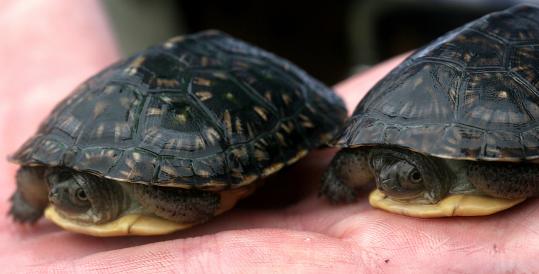
They decided to focus on the Blanding's turtle, a medium-sized, semiaquatic species distinguished by its bright yellow chin and throat, dark olive color with irregular yellow spots, and a highly domed and smooth carapace.

The species travels long distances during its active season, does not reproduce until late in life, and has low nest survival - all of which contribute to it being a threatened species. Its habitat in Devens was divided by a main road, Noberini said. This left the turtles susceptible to getting hit by traffic when they crossed the street, said Lori Erb, a turtle conservation biologist with the Massachusetts Division of Fisheries and Wildlife.

"People told me about some Blanding's turtles that were being hit in upwards of eight per year, which is a lot, by cars on this one particular stretch of road," said Erb, who would not disclose the exact location because of poachers potentially targeting the creature.

The state Highway Department and the Department of Fish and Game then teamed up to build a chain-link fence to keep the turtles in, but holes in the bottoms still allowed them to escape. Patching these holes with chicken wire became the first task that about 15 Bristol-Myers Squibb employees, along with their partners and other volunteers, completed in early April, Noberini said.

The fence has since proven successful. Four turtles were hit by cars this year, none of which were Blanding's, compared with 43 turtles last year, five of which were Blanding's, Erb said.

Erb said the well-being of this species is important, as it's a good indicator of the well-being of the environment. "They're a top predator in the system. It's important to keep them in because you never know what sort of trickle-down effects might occur in the system if you take out a keystone species," she said. Blanding's turtles eat plants, such as coontail and duckweed, as well as animals, such as crayfish and earthworms.

Noberini said even though the Devens facility won't open until late 2009, Bristol-Myers Squibb employees have also engaged in other environmentally focused activities in the area, including a celebration on Earth Day to educate other company employees. In May, volunteers from the company also helped remove trees and brush to help create a better nesting habitat for the turtles.

In September, they will help restore nesting areas at a local hiking trail. Company officials also will meet twice a year with interested parties to make sure their resources go to the right place, Noberini said.

He said he believes these types of public-private partnerships may become more and more common.

"I think it's a wave of the future," he said. "A lot of people are getting into the environmental sustainability and green movement, and this is really an extension of that."


© Copyright 2008 Globe Newspaper Company.

Archival Transfer 2008

Rare turtle washes up on Cape Cod

July 4, 2008

Cape Cod had an unusual visitor from the open ocean Wednesday night. A dead leatherback sea turtle weighing several hundred pounds washed ashore at Popponesset Beach in Mashpee, a spokesman for the New England Aquarium said.

Tony LaCasse said leatherbacks are an endangered species. This one was 6 to 7 feet across and had been dead for a long time.

The body was too decomposed for an necropsy to be performed, he said.

A biologist from the University of New Hampshire, which is working with the aquarium and the Massachusetts Audubon Society to research the turtles, took tissue samples and measured the body before it was removed from the beach, LaCasse said.

It is unusual for a leatherback to wash ashore on a Massachusetts beach, because they stay in the open water where they feed on jellyfish, he added.

Some leatherbacks have been found weighing as much as a ton.

Leatherbacks are unusual reptiles, LaCasse said, in that they can shunt blood to their outer extremities. This allows them to travel to colder temperatures than most turtles, as far as the Gulf of Maine and the Canadian sea provinces.

ANNE BAKER

Chris Bogard with a Snapping Turtle


Turtles have a friend in Epping

By KATHLEEN D. BAILEY
Special to the Union Leader

June 24, 2008

Chris Bogard cooed to a 20-pound snapping turtle as she lifted the female onto a towel on her kitchen counter.

"She's a very pretty girl," Bogard said, "and she's healing very nicely."

Good thing, she added, because the snapper is "loaded" with eggs.

Bogard, a licensed turtle rehabilitator, isn't always so lucky. Sometimes she can't save the turtles people bring to her, in her private life and at her part-time job at a turtle hospital in Massachusetts. May to July is the prime time for turtles to be out and about -- and to be hit by cars.

Bogard has two words for the general public: "Slow down."

Article here.


Endangered Turtles Get Headstart at Museum

By Tammy Daniels - June 04, 2008
iBerkshires Staff

Northern red-bellied cooter
[Photo by MassWildlife]
PITTSFIELD — The nursery at Berkshire Museum was emptied on Friday as its nearly dozen occupants were handed over the state Fish and Wildlife Department.

Over an eight-month period, 10 turtles — known as northern red-bellied cooters — were kept warm and fed in the museum's aquarium section. It's all part of a "headstart" program to help the endangered species thrive in their small pocket of Massachusetts.

"We're really at the very northernmost point of their habitat," said aquarium manager Scott Jervas on Friday, after dropping the cooters off at MassWildlife in Westborough. "We're trying to push the habitat out a little bit."

And that habitat is small — about a dozen ponds in Plymouth County. When the headstart program began in 1984, there were an estimated 300 turtles. Now they number in the low thousands.

Over the past 20 years, some 2,000 of the young reptiles have been fostered and returned to the wild.

The museum joined the program in its early years, said Jervis, and usually brings about 10 of the creatures to the far western corner of the state to spend the winter months in water tub kept at a balmy 86 degrees.

The turtles breed late in the year and lay about 14 eggs; they don't reach reproductive maturity until at least 13 years. The cooters can live up to about 70 years.

Their limited habitat (caused in part by human encroachment) within about a dozen small ponds in Plymouth County and their slow movement leaves their young vulnerable to a host of predators. Their small size and high nutritional needs in their formative months also takes a toll on the species' ability to winter over.

MassWildlife and volunteers literally stake out the nests and scoop the baby turtles up when they hatch to prevent herons, bullfrogs and other predators from snatching them up. They're divvied out to between 15 and 20 zoos, schools, aquariums and volunteers across the state. This year, about 150 were fostered.

"They're constantly supplied with food — primarily romaine lettuce — and have to eat a lot to extract what little nutrition there is," said Jervas, who's been at the museum for 12 years.

What goes in eventually comes out — and a lot of it. The museum tried to care for 16 turtles one year, but that was just too messy, he said.

But all that food translates into rapid growth. "They're about the size of a quarter with a little head and legs when we get them," said Jervas. "They grow to over 2 pounds over the eight or nine months."

The turtles pack on 50 to 70 grams a week and have to be weighed and measured regularly and that falls to the students from Miss Hall's School who are part of an intern program at the museum. By the time the turtles are ready to be released in the spring, they've reached a size that keeps them safe from most predators

They're the second largest freshwater turtle in the state, with adults reaching more than a foot long and weighing up to 10 pounds.

The fostered turtles were returned to MassWildlife on Friday for their final weigh-in; they were released back into the wild on Monday.

Jervas brought his now big turtles to join their cousins and catch up with fellow fostering volunteers at the traditional cookout afterward.

"It's always good to see everyone and compare notes," he said.
Photo from the Berkshire Museum.


The Enterprise
Posted Jun 04, 2008 @ 02:10 AM
BROCKTON —

TURTLES GONE WILD: In case you missed it live on Monday morning on the shores of Great Quittacas Pond, the Ceremony of the Turtles will begin airing on Friday at 6 p.m. on BTV, Bridgewater’s public access station. The segment will include a Native American blessing of the turtles, which were given a head start by volunteers over the winter, to give them an edge over predators. The simple but moving ceremony, performed by Chief Alden “Windsong” Blake, tribal head of the Assonet tribe of Indians, was a blessing for the Native peoples’ most powerful and sacred animal, the turtle. On Monday, the Division of Fisheries and Wildlife released 137 red-belly cooters into Great Quittacas Pond in Middleboro, and the Comcast crew captured it on film.


Endangered turtles get a head start at life

By Scott O’connell

Mon Jun 02, 2008, 03:41 AM EDT

WESTBORO -

Thanks to the efforts of MassWildlife, a small population of endangered turtles in Plymouth County is getting a better chance at survival.

In a process called “head-starting,” the state agency division gathered about 150 northern red-bellied cooter hatchlings from the wild last fall and distributed them among 17 caretakers ranging from zoos to high schools.

The volunteer caretakers raised the turtles in aquariums over the winter in preparation for their release back into the wild.

At MassWildlife’s field headquarters in Westboro on Wednesday, this year’s head-starting graduates were weighed a final time in preparation for their release today into the Great Quittacas and Pocksha ponds in Middleboro, just a few miles from the turtles’ original habitat.

Tom French, assistant director of MassWildlife’s Natural Heritage and Endangered Species Program, said the aim of head-starting is to help the hatchlings grow to a size that won’t be gobbled up by other species.

Though adult northern red-bellied cooters are the second largest freshwater turtle species in Massachusetts, measuring up to a foot long, they’re only the size of a quarter when they hatch from their eggs.

“Everything can eat them,” French said. “They’re easy to find, easy to catch and they usually get eaten up.”

Now in its 24th year, MassWildlife’s head-starting project has replenished a turtle population that numbered only 300 across 12 ponds in Plymouth County in the beginning.

Were it not for MassWildlife’s intervention, French believes the species, which has more stable populations along the southern East Coast, could have gone extinct in Massachusetts.

“They were showing signs they were headed that way,” he said. “Basically, (head-starting) works.”

According to French, several of the turtles had already grown to several times the size of their counterparts in the wild, thanks to a winter of steady feeding.

“The results are actually quite remarkable,” he said. “Once you get it to this size, nothing can hit it.”


Why did the turtle cross the road?

ANDOVER — Make way for turtles.

That's what the Shawsheen River Watershed Association is trying to get across with new "turtle crossing" signs that will start going up this week around the area.

The group is concerned that cars could run over the small shelled creatures.

May and June are mating season for turtles, and research shows that turtles are most likely to be run over crossing roads and highways to lay their eggs in ideal sunny, sandy spots.

If you see a turtle in the road, the SWRA suggests picking it up and bringing it where it was headed. Don't return it where it was coming from, because it will only make its way into the road again.

Contact the SWRA at www.shawsheen.org if you live on a road where turtles cross and would like a sign.